

 13% off
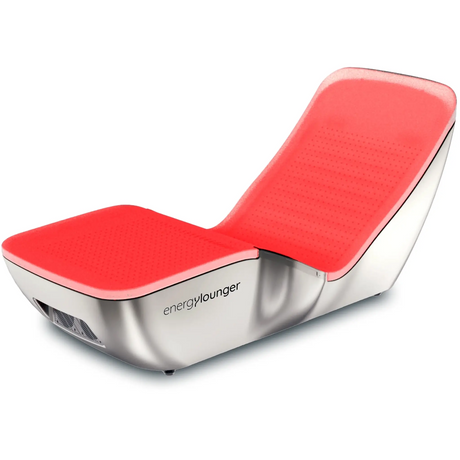
Red Light Full Body Therapy Bed by Energy Lounger
Commercial Grade
Sale price $35,00000 Regular price $40,00000Unit priceUnavailable
11 Energy Lounger Questions Buyers Ask
A panel projects light at one body region at a time and forces the user to rotate. The Energy Lounger surrounds the body with 1,260 LEDs across 21 panels in a single 20-minute session — one client in, one client out.
For a commercial operator, the difference is throughput and dose consistency. With a panel, a client treats the front of the body, flips, treats the back, and re-positions to hit shoulders or hips — and they're guessing at distance from the panel, which directly affects irradiance.
The Energy Lounger is built around a fixed-geometry cabin: 21 LED panels positioned at consistent angles to the body, 60-degree output spread, and a 20-minute manufacturer-recommended session that doesn't require any client-side positioning. Booking software can schedule sessions back-to-back without buffer time for client repositioning.
That same fixed geometry is what makes the per-session experience feel like a treatment rather than a self-administered device. Panels do a job; the lounger does it for them.
- 1,260 LEDs across 21 panels surround the body in one position
- 20-minute manufacturer-recommended session vs multi-position panel protocol
- Fixed LED-to-body geometry — consistent dose every session
- Built for back-to-back commercial booking, not self-administered home use
- Comparable to NovoTHOR-class commercial beds at a lower capital outlay
Three wavelengths: 630nm visible red, 850nm near-infrared, and 950nm near-infrared. Red targets surface tissue and skin; the two near-infrared bands penetrate deeper into muscle and joint tissue.
The 630nm band is in the visible-red range absorbed strongly by skin, capillaries, and superficial connective tissue. The 850nm and 950nm bands sit in the near-infrared range and penetrate further — published research on photobiomodulation reports near-infrared around 850nm penetrating roughly 2–3cm deeper than red light, which is why it's the band most cited in muscle-recovery and joint studies.
The Energy Lounger ships with five preset modes that combine these wavelengths for different goals: Skin Rejuvenation (630nm), Muscle Recovery (630nm + 850nm), Pain Management (630nm + 950nm), Immunity Boost (850nm + 950nm), and Full Spectrum (all three). Modes are selected from the unit or via the Energy Lounger app over Bluetooth, so an operator can preset a client's preferred mode against their booking record.
None of these modes is a medical treatment for a named disease — they're wellness presets that match the published photobiomodulation (PBM) literature on each wavelength's tissue interaction.
- 630nm visible red — skin, collagen, surface circulation
- 850nm near-infrared — deeper muscle and joint tissue
- 950nm near-infrared — deepest penetration of the three
- 5 preset modes combine wavelengths for specific goals
- Mode selection via on-unit button or Bluetooth app
The manufacturer recommends 20-minute sessions. Frequency depends on the client's goal — published research on photobiomodulation typically uses 3–5 sessions per week over multiple weeks for muscle-recovery and pain-relief protocols.
Energy Lounger publishes 20 minutes as the standard session length across all five modes. The unit's capacitive sensors and cooling fans are sized for that duration, and back-to-back 20-minute sessions are how most commercial operators model bookings.
Cadence is where it gets client-specific. Published photobiomodulation research on muscle recovery, joint discomfort, and skin outcomes generally uses 3–5 sessions per week over 4–12 weeks — not single one-off sessions. That cadence is also what supports the per-session revenue math operators run: a client buying a 10-pack or membership is the unit economics, not single-session walk-ins.
Operators usually let clients self-select frequency after an initial education conversation. The lounger doesn't require staff supervision during the session, so booked time blocks can be tightly scheduled.
- Manufacturer-recommended session length: 20 minutes
- Published PBM research typically uses 3–5 sessions per week
- Multi-week protocols (4–12 weeks) are standard in the literature
- Memberships and 10-packs match the cadence buyers actually use
- No staff supervision required during the session itself
Photobiomodulation has a real peer-reviewed evidence base for muscle recovery, joint discomfort, and skin outcomes. It is not a clinically proven treatment for named diseases, and the Energy Lounger is sold as a wellness device, not a cleared medical device.
The mechanism — red and near-infrared photons absorbed by mitochondrial cytochrome c oxidase, increasing ATP production — is well-established across decades of PBM literature (PMC and PubMed have hundreds of studies indexed). Specific outcomes with stronger evidence include reduced post-exercise creatine kinase and DOMS severity, improved short-term recovery markers after resistance exercise, and skin-level outcomes like collagen activity.
What the literature does not support is treating the device as a cure for named medical conditions. Studies show effect sizes that range from modest to meaningful depending on protocol, wavelength, dose, and population — not blanket cures. Operators who position red light therapy as a recovery and wellness amenity stay on solid ground. Operators who claim it treats Alzheimer's, cancer, or any specific disease are outside what the Energy Lounger is sold for and outside what BSF will support in marketing copy.
If a buyer is researching clinical-grade red light for a medical-practice setting, NovoTHOR is the FDA Class II cleared option at a higher price tier. The Energy Lounger sits in the commercial-wellness tier — one step below clinical, well above residential panels.
- PBM mechanism is well-established in peer-reviewed literature
- Stronger evidence: muscle recovery, DOMS, skin outcomes
- Energy Lounger is a wellness device, not an FDA-cleared medical device
- NovoTHOR is the FDA Class II option for clinical-grade settings
- Don't market the lounger as a treatment for named diseases
Commercial red light sessions typically retail at $50–$100 nationally, with packages and memberships dropping the effective per-session rate to $20–$60. Operators serving 10–15 clients per day per bed at those rates regularly model $10K–$20K of monthly revenue per bed.
The math is straightforward. A 20-minute session block, including a few minutes for client transition, lets a single bed run 18–20 sessions across an 8-hour operating day. Real-world utilization is rarely 100% — 50–60% utilization is a more honest planning number once a location is established.
At a $60 average revenue per session and 12 sessions per day, a single bed produces roughly $720 per day, $14,400 per month, $172,800 per year before staff and overhead. Memberships and 10-packs lower the per-session rate but raise predictable utilization — the trade most operators make once they're past the early-adoption phase.
Throughput is where the Energy Lounger's full-body form factor pays off. Panel-based setups force longer session times for full-body coverage, so the same 8-hour day produces fewer billable sessions. Energy Lounger's manufacturer ships an ROI calculator with the device that lets operators model their own assumptions on local pricing, hours, and utilization.
- National per-session pricing: $50–$100 standalone, $20–$60 in packages
- Capacity: 18–20 sessions/day per bed at 20-min blocks
- Real-world utilization: 50–60% once a location is established
- Memberships and packages stabilize utilization, lower per-session rate
- Manufacturer ships an ROI calculator with the device for local modeling
Commercial wellness operators — gyms, recovery centers, day spas, hotels and resorts, chiropractic and PT clinics, and corporate wellness rooms. It's a B2B commercial-grade unit, not a residential device.
The form factor and price point are sized for facilities that bill clients per session or include red light as a member amenity. Recovery centers and chiropractic / PT clinics use it as an add-on revenue line alongside cold plunge, percussion therapy, and stretch services. Day spas and hotel spas position it as a premium amenity and bundle it with massage or facial services. Commercial gyms and recovery-focused fitness clubs offer it as a tiered membership perk.
Less-obvious fits we see working: senior wellness facilities running mobility-and-recovery programs, corporate wellness rooms in companies with 200+ on-site employees, and concierge medical practices building out recovery suites. The common thread is recurring client volume — a single-tenant residential install rarely justifies the spend.
Authorized dealer status and freight coordination matter for any of these settings — this isn't a parcel-shipped panel. BSF coordinates LTL freight, liftgate, and install logistics on every order.
- Commercial gyms and recovery-focused fitness clubs
- Recovery centers, chiropractic / PT clinics, sports performance facilities
- Day spas, hotel and resort spas, salon recovery suites
- Corporate wellness rooms, concierge medical practices, senior wellness facilities
- Built for repeated commercial use, not residential single-user setups
Standard 120V, 15-amp dedicated household outlet. Footprint: 74" long x 33" wide x 34" tall (open). Plan for 1–2 feet of clearance on each side for client access and ventilation.
Electrically, the Energy Lounger is plug-and-play on a standard 120V/15A circuit — no high-voltage 240V install, no commercial electrician callout for most sites. The unit's onboard cooling fans handle heat dissipation, so a treatment room doesn't need dedicated HVAC additions for a single bed. For multi-bed installs in a small room, factor in higher ambient heat load and consult your facility HVAC plan.
Footprint planning: the 74" x 33" x 34" closed dimension is the bed itself. For a usable treatment room, plan on roughly 8′ x 6′ minimum — that gives the bed itself, client transition space, and room for the canopy to open without contact. Ceiling clearance over 7′ is comfortable; 8′ gives more headroom for taller clients on entry.
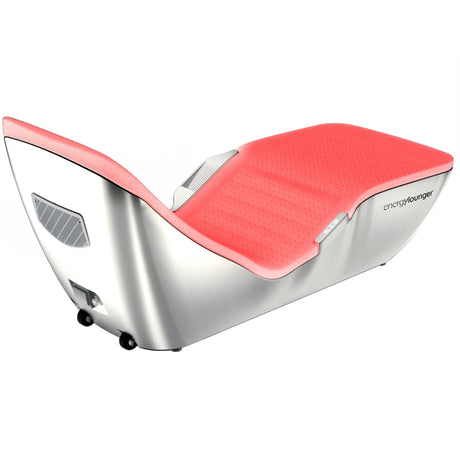
The unit ships fully assembled with mobility wheels for repositioning, and IPX4 water/sweat rating allows wipe-down sanitation between clients without sealing electronics from spray.
- Power: 120V / 15-amp standard household outlet (dedicated)
- Bed footprint: 74" L x 33" W x 34" H
- Recommended room size: 8′ x 6′ minimum for client access
- No specialized HVAC required for a single-bed install
- IPX4 sweat/wipe-down rating for between-client sanitation
- Ships fully assembled with rear mobility wheels
2-year commercial warranty from Energy Lounger. BSF coordinates LTL freight delivery (5–7 day transit after a roughly 7-day order-to-ship window), and the unit arrives fully assembled with liftgate service included.
Energy Lounger backs the unit with a 2-year commercial warranty for B2B operators — sized for the repeated-use environment a spa or gym puts on the device. The 21 LED panels are user-replaceable, which matters over the long tail: an individual panel can be swapped in the field without sending the entire bed back to the manufacturer.
On freight: BSF orders typically ship within roughly 7 days of order, with a 5–7 day LTL transit. The bed weighs 243 lbs and ships fully assembled, so install is plug-and-play on arrival. We coordinate the freight relationship — you get a delivery window, liftgate service is included by default, and if anything arrives damaged BSF files the carrier claim and pushes the replacement.
For multi-bed orders, lead times can stretch depending on inventory; bulk-order pricing improves at quantity. Lead estimates are listed on every quote.
- 2-year commercial warranty from Energy Lounger
- Order-to-ship: roughly 7 days; transit: 5–7 days LTL
- Liftgate service included; bed arrives fully assembled
- 21 LED panels are user-replaceable in the field
- BSF handles freight claims directly — not pushed onto the buyer
- Lead estimates listed on every quote
Wipe-down with a non-abrasive surface disinfectant after each session. The IPX4 water-resistance rating allows damp-cloth sanitation without risk to the LED panels or electronics underneath.
Between-client sanitation is the spa-and-gym-operator question that comes up first. The Energy Lounger's HDPE construction surface is non-porous, which means standard surface disinfectants used on massage tables and other commercial wellness equipment work without damaging the material.
The IPX4 rating covers protection against water splash from any direction — sufficient for damp-cloth wipe-down between clients but not for spray cleaning or pressure washing. Most operators run a 2–3 minute wipe-down protocol between sessions: surface disinfectant on the lying surface, around the head and foot wells, and any hand-contact controls. That timing fits inside the natural buffer between 20-minute back-to-back bookings.
For higher-volume facilities, disposable single-use barrier sheets can be layered over the lying surface to reduce the between-session sanitation cycle further. Energy Lounger doesn't sell barrier sheets — they're standard spa supplies.
- Non-porous HDPE surface accepts standard wellness-equipment disinfectants
- IPX4 rating supports damp-cloth wipe-down (not spray or pressure wash)
- 2–3 minute between-session protocol fits 20-minute booking buffer
- Disposable barrier sheets are an option for high-volume facilities
- 21 LED panels are sealed against splash; no opening required for sanitation
Eye protection is recommended for clients during sessions. Clients on photosensitizing medication, with active eye disease, or with photosensitive seizure history should consult their physician before use. The Energy Lounger is not appropriate for clients with active cancer in the treatment area without physician clearance.
Red and near-infrared light therapy is generally well-tolerated, but two safety areas matter for any commercial operator: eye exposure and photosensitivity. Direct prolonged exposure to bright LED arrays can cause eye strain or temporary discomfort, particularly for clients with pre-existing eye conditions like cataracts, glaucoma, or recent eye surgery. Standard practice is to provide opaque or tinted eye-protection goggles for every session.
Photosensitivity is the second area. Clients on common photosensitizing medications — tetracyclines, doxycycline, retinoids, certain NSAIDs and diuretics, amiodarone, chlorpromazine, or chemotherapy — can experience heightened skin reactivity even to non-UV light. Clients with porphyria, lupus, or albinism should also consult their physician before booking.
Other commonly cited contraindications include active cancer in the treatment area (without oncologist clearance), uncontrolled photosensitive epilepsy, and pregnancy (manufacturer guidance recommends physician clearance). None of these are absolute bans — they're physician-consultation flags. A standard intake form and waiver covers the operator and steers high-risk clients to the right consultation.
- Eye-protection goggles recommended for every session
- Photosensitizing medications are the most common reactive case
- Active cancer in treatment area — physician clearance required
- Pregnancy — manufacturer recommends physician clearance
- Standard client-intake form + waiver covers the operator
- Most contraindications are consultation flags, not absolute bans
Red light therapy sessions can qualify for FSA or HSA reimbursement when the client has a Letter of Medical Necessity (LMN) from a licensed healthcare provider. Without an LMN, the IRS classifies it as a general-wellness expense and it's not eligible.
This question matters for any operator whose clients are looking to use FSA or HSA funds against their session packages. The IRS classifies red light therapy as a "dual-purpose" item under Publication 502 — it can be used for general wellness or for treating a specific health condition, so eligibility depends on the buyer's documentation.
With a valid LMN dated on or before the purchase date, FSA / HSA funds typically reimburse session purchases for conditions like chronic pain, inflammation, or wound healing. Clients can request an LMN from their primary care physician, dermatologist, physical therapist, or chiropractor. Online services like TrueMed issue LMNs after a brief intake, usually within 24–48 hours.
For a commercial operator, the practical move is to mention LMN-based reimbursement on intake materials so eligible clients know to ask their provider, but not to advertise the device itself as "FSA / HSA eligible" — that framing skips the LMN step and isn't accurate. The operator's role is to provide the session and a clear receipt; the LMN process is between the client and their plan administrator.
- Eligibility requires a Letter of Medical Necessity (LMN), not automatic
- LMN must be dated on or before the purchase — backdating is invalid
- Issued by a licensed healthcare provider (PCP, derm, PT, chiro)
- Online services (e.g. TrueMed) issue LMNs within 24–48 hours
- Don't market the device itself as "FSA/HSA eligible" — receipts only
